Signs Your Car Needs a Wheel Alignment
September 30, 2026
QUICK ANSWER: A car that pulls to one side, has an off center steering wheel, or shows wear on one edge of the tread is usually out of alignment. Feathered tread, a steering wheel that will not return to center after a turn, and faster wear on one axle are common signs too. Highway speed vibration is more often a wheel balance or tire issue than an alignment problem, though a shop should check both at once. Camber, caster, and toe are the three angles a technician measures, and any of them can shift after a pothole strike, a curb hit, or a collision. A reading on an alignment rack is the only way to confirm which angle moved and by how much.
Hit a pothole hard enough on US 20 and you feel it in the wheel before you feel it anywhere else. A thud, a shimmy, then nothing. The car seems to drive fine for a mile or two before you notice it is not quite tracking straight anymore. That small drift is usually the first sign an alignment angle moved, and most drivers wait weeks before they do anything about it.
Alignment trouble rarely comes with a warning light. It shows up as a feeling in your hands, a sound from the tires, or a shape worn into the tread, and each one points toward a different angle inside the suspension. Camber, caster, and toe each fail in their own way, and reading the symptom correctly can save a set of tires that would otherwise wear out months early.
We measure alignment angles daily across Chesterton and the rest of Porter County, where freeze thaw cycles crack open potholes every spring and road salt works its way into bushings and tie rod ends every winter. The signs below cover what we see most, from a car that pulls on a flat road to a steering wheel that will not sit still.
What Camber, Caster, and Toe Actually Control
Camber is the inward or outward lean of a wheel when you look at the car head on. Too much negative camber wears the inside edge of a tire. Too much positive camber wears the outside edge. Caster is the tilt of the steering axis viewed from the side, and it decides how firmly a wheel wants to return to center after you take a turn. Toe is whether the front tires point slightly toward each other or away from each other, and of the three, it erodes tread the fastest. A single hard pothole strike can move toe without bending a single part you could ever spot by looking at the wheel well.
None of the three angles are guesswork. The National Highway Traffic Safety Administration lists
wheel alignment alongside tire balance as maintenance that protects tread life and keeps a car from veering on a flat, level road. The U.S. Tire Manufacturers Association makes a similar point specifically about road hazards, noting that striking a pothole or curb can throw off alignment and lead to uneven, rapid tread wear even when nothing about the vehicle looks bent from the outside.
Your Car Pulls to One Side on a Flat Road
A pull is the sign most drivers notice first because you feel it with almost no effort. Take your hands nearly off the wheel on a straight, level stretch and the car should hold its line. If it drifts left or right instead, camber or toe is usually uneven from one side of the car to the other.
Before you assume alignment, though, rule out the simple explanation. Underinflated tires or a tire that is wearing unevenly on one side can pull a car almost as hard as a bad alignment angle can, and checking pressure takes a minute with a gauge you already own. If the pressures match and the pull is still there, that is when the angles need to go on a rack. A pull that shows up only under braking often points at a sticking brake caliper rather than alignment at all, so the direction and timing of the drift both matter when you describe it.
The Steering Wheel Sits Off Center or Will Not Return After a Turn
Two separate symptoms live in this category, and they mean two different things. A steering wheel that sits crooked while the car still tracks straight down the road usually means toe was split unevenly between the two front wheels at some point. The car is fine mechanically. It just looks wrong every time you glance down at the wheel.
A wheel that will not return to center on its own after a turn is a different story. That points at caster, the angle that gives the steering its self centering feel. Weak or uneven caster leaves the wheel feeling loose mid turn and reluctant to straighten out afterward, which is more than cosmetic. It changes how the car behaves in an emergency lane change, and it is worth having checked sooner rather than later.
TIP: Note the exact moment a symptom starts, whether that was a pothole on Indiana 49, a curb tap while parking, or nothing you can point to at all. That single detail narrows down which angle moved before the car even gets on the rack.
Reading Tire Wear Patterns Correctly
Tread tells a story if you know how to read it, and it is one of the most reliable signs available because it does not lie the way a subjective feeling can. Run your hand across the face of each front tire, not just a glance from a few feet away.
Wear concentrated on one edge of the tread, inside or outside, usually points at camber.
Feathering, where the tread blocks feel smooth running your hand one direction and rough running it the other, is the signature of toe being out of specification.
Wear evenly spread across both edges with the center left higher is more often underinflation than alignment, so check pressure before you assume the angles are the culprit.
Cupping, a scalloped or wavy wear pattern, usually traces back to worn shocks or struts rather than alignment at all, since a suspension component that cannot control wheel bounce lets the tire hop against the road instead of tracking it smoothly.
Getting the diagnosis right matters because fixing the wrong system leaves the real problem, and the tire, to keep wearing out.
Vibration and Noise: When It Is Not Actually Alignment
A vibration through the steering wheel at highway speed feels like it should be an alignment problem, and drivers ask about it constantly. Most of the time it is not. Vibration at speed is far more often wheel balance or a bent rim, while alignment shows up as pulling and uneven wear rather than shake. A shop worth its rack checks both together rather than adjusting angles and hoping the shake goes away on its own.
Noise is a different clue. Tires that squeal during a low speed turn, especially one you have taken the same way for years without a sound, can mean the front end is scrubbing at an angle it was never set up to hold. That is worth mentioning to a technician even if nothing else on this list feels familiar yet.
What Throws Alignment Out Around Chesterton and Porter County
Every spring thaw opens holes in the roads around Chesterton, Portage, and Valparaiso faster than crews can patch them, and a single hard strike is enough to push toe out of specification without bending a visible part. Add winter road salt working into tie rod ends and control arm bushings along I-94 and US 20, and adjusters that turned freely in October can seize by February. New tires deserve a rack before they roll too, since fitting fresh rubber onto a car that is already out of specification just wastes the new set on the same schedule the old one wore out on..
WARNING: A pull, an off center wheel, or a shake at speed can also come from a worn tie rod end, a failing ball joint, or a sagging spring, all of which are steering and suspension parts rather than alignment settings. Adjusting angles on a loose component produces numbers that look correct on paper and drift right back out within weeks, so those parts need to be inspected before any adjustment is trusted.
What a Professional Alignment Check Actually Involves
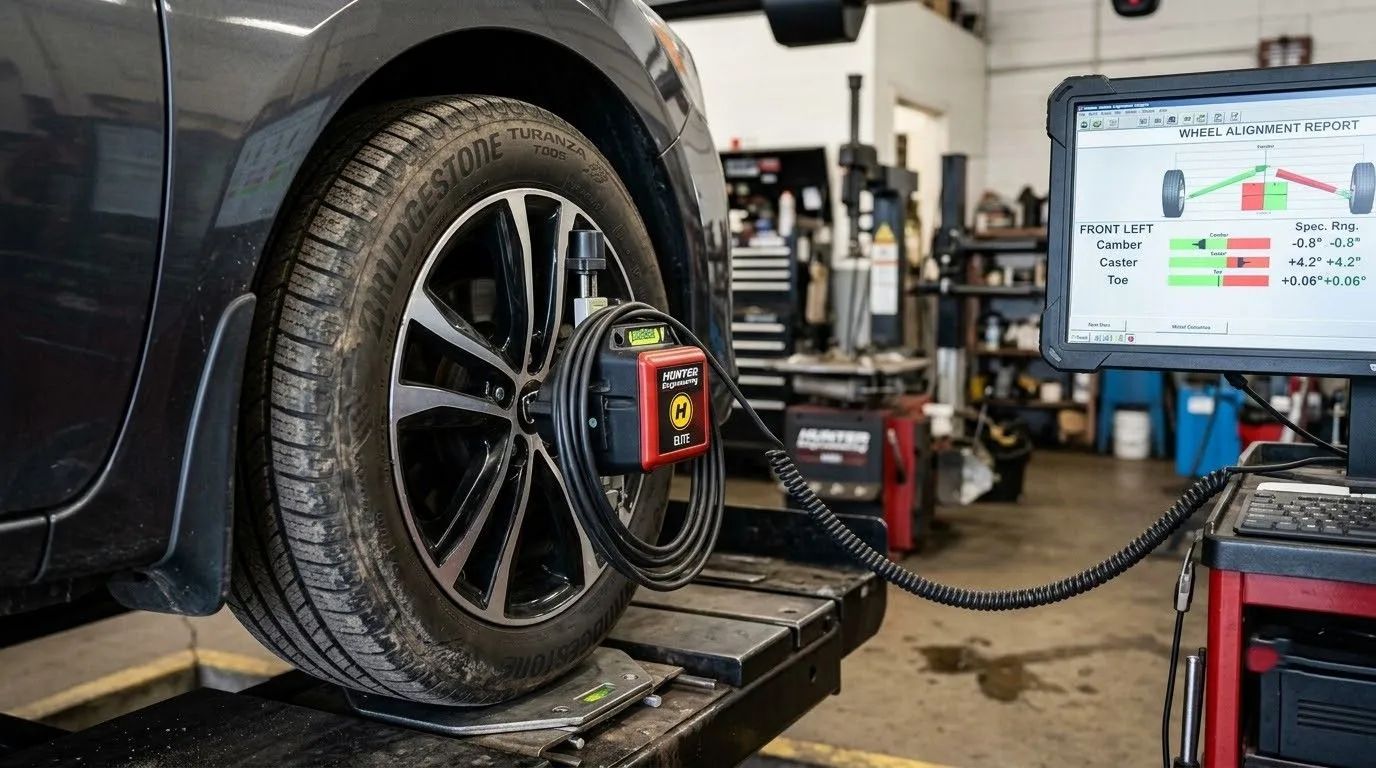
A real alignment check starts before the car ever touches the rack. Tire pressure gets set to the door placard first, because uneven pressure skews every reading taken afterward. Steering and suspension components get inspected next: tie rods, ball joints, bushings, wheel bearings, and ride height, since adjusting a worn part is a wasted step. Only then do targets go on all four wheels so camber, caster, toe, and thrust angle can be measured against the specification published for that exact make and model, not a generic setting.
Once the numbers are in hand, each angle gets brought inside its published tolerance, with toe split evenly so the steering wheel actually returns to center instead of sitting crooked again. A road test confirms the car tracks straight, and the printed before and after readings are what prove the work happened. Numbers on paper settle a question no verbal description ever fully answers.
Frequently Asked Questions
Can I keep driving if my car is out of alignment?
You can, but every mile adds wear you cannot get back, and the effect compounds over time. Handling in a sudden lane change also gets less predictable.
How much can one pothole strike move an alignment angle?
More than most drivers expect. Toe is most sensitive to impact, and a hard hit can shift it enough to start feathering the tread within days.
Does a minor curb tap during parking really throw off alignment?
It can. A slow tap that barely scuffs a wheel cover can nudge toe out of specification, especially on a vehicle already close to tolerance.
How much faster do tires wear once a car is out of alignment?
It depends on which angle moved, but camber or toe well outside specification can wear through one edge months before the rest of the tire wears.
Do all four tires wear evenly if only the front alignment is off?
No. Front camber and toe problems concentrate wear on the front tires unevenly, while a rear alignment issue can also affect how the front tracks.
Can alignment drift even if I have not hit anything?
Yes, though slower. Rubber bushings age and soften over miles, and ride height settles as springs wear, shifting camber and caster without any impact.
What Every Alignment Symptom Is Really Telling You
A pull, a crooked wheel, or a feathered tread edge is never just a nuisance to live with. Each one points back to camber, caster, or toe sitting outside where it should be, and ignoring the symptom only lets the wrong tire wear out faster while the real cause stays untouched. Reading the sign correctly, rather than guessing which fix might help, is what keeps a pothole strike from turning into a set of tires replaced months before their time.
LUKE'S ALIGNMENT & AUTO REPAIR
has spent 40
years measuring alignment angles across Chesterton, IN, through freeze thaw seasons that open potholes faster than crews can patch them. That kind of repetition is why a printed reading, not a guess from behind the wheel, settles the question every time. A car that tracks straight again after the right angle gets corrected tends to stay that way for a long stretch of road.