Camber, Caster, and Toe: What Each Alignment Angle Actually Does
October 9, 2026
QUICK ANSWER: Camber is the sideways lean of a wheel seen from the front, caster is the forward or backward tilt of the steering axis seen from the side, and toe is the direction the tires point seen from above. Camber and toe are the angles that wear tread, with toe doing the fastest damage. Caster mostly shapes straight line stability and how well the steering wheel returns to center. Each angle has a published specification for your exact make and model, and the three work as a set, so a technician measures all of them, plus the rear thrust angle, before changing any single one.
Most drivers meet the words camber, caster, and toe on a printout, usually a column of numbers with a few lines highlighted in red. The numbers mean something specific, and once you know what each angle does, the printout stops being a puzzle and starts being a map of what your suspension is doing.
Here is the short version. Camber is lean. Caster is tilt. Toe is aim. Three simple ideas, but they interact, and a shop that treats them as separate dials will chase the same pull and the same tire wear for months. We have been setting these angles for 40 years, and the pattern holds on every make and model that rolls onto our rack, domestic or import.
The conditions around Chesterton make this more than trivia. Pavement across Porter County cracks, takes on meltwater, freezes, and breaks apart every late winter. Indiana public radio reported that pothole season in the state runs from February into early April, driven by water seeping into cracks and freezing and thawing again and again until traffic pulls the pavement loose. Every one of those holes on US 20, Indiana 49, or a side street in Portage is a chance for a front wheel to take a sudden sideways jolt. This guide walks through what each angle controls, how each one shows up in your hands and on your tires, and why the angles have to be read together.
Camber: The Lean of the Wheel
Stand in front of your car and look at a front tire. If the top of the wheel leans toward the car, that is negative camber. If the top leans away from the car, that is positive camber. A wheel standing perfectly vertical has zero camber. Camber is measured in degrees, and manufacturers set a specific target for each vehicle.
A tire wears best when its whole tread face meets the road evenly. Technical references on alignment note that zero camber produces the least tire wear, while a wheel that leans puts more load on one shoulder of the tread. Positive camber loads the outer edge, and negative camber loads the inner edge. Engineers do build small amounts of camber into suspensions on purpose, because a slight lean helps the tire grip in a turn and helps the steering feel settled. At the factory setting, that lean causes little visible wear. The trouble starts when the angle drifts well past its range.
Camber also affects pull. When the two front wheels carry unequal camber, the car tends to drift toward the side with the more positive reading, the same way a tilted cone wants to roll toward its small end. A driver feels this as a steady lean on the steering wheel on a flat, empty road, even when the tires are inflated evenly and the wheel itself is not off center.
What shifts camber. Bent or worn control arms, sagging springs, worn ball joints, and a hard strike on a curb or pothole edge can all change it. On many vehicles camber is not even adjustable with the usual hardware, which is one reason a camber reading that has moved often points to a worn or bent part instead of a setting that simply needs a turn of a bolt.
Toe: The Direction the Tires Point
Look down on the car from above. If the front edges of the two front tires point slightly toward each other, that is toe in. If they point away from each other, that is toe out. Zero toe means both tires point dead ahead and roll parallel. Toe is usually measured in small fractions of a degree or in fractions of an inch across the tire, which is why a tiny change matters so much.
Toe is the angle that wears tires fastest. When toe is off, the tires are not rolling straight. They are dragging slightly sideways with every revolution, scrubbing the tread against the pavement. Alignment references describe the resulting pattern as feathering, where each tread block is worn to a thin edge on one side. Run your palm across the tire and the blocks feel smooth in one direction and sharp in the other. Too much toe in tends to wear the outside edges with the feathering on the inside, and too much toe out does the opposite.
Toe also decides how the front end behaves on the highway. Rear wheel drive vehicles are often set with a small amount of toe in, while front wheel drive vehicles are often set with a small amount of toe out. The reason is that driving forces and the flex in the steering linkage change the wheel position once the car is moving, and the target is to have the wheels run straight at speed rather than straight in the driveway. That is a detail only a published specification for your exact vehicle can settle, which is why generic settings never get us the result a proper rack procedure does.
TIP: Toe is the angle most easily changed by a quick impact, and it is also the one you can partly see in your tires. If the front tread feels like a saw blade when you run your hand across it, toe has probably been out for a while, and the tire is telling you the date it started.
Caster: The Tilt That Makes the Wheel Come Back
Now picture the car from the side. The steering axis is the imaginary line running through the upper and lower pivot points of the front suspension, such as the ball joints or the top strut mount and the lower ball joint. Caster is how far that line tilts forward or backward from vertical. If the top of the line leans toward the driver, caster is positive. If it leans toward the front of the car, caster is negative.
Think of the front wheel on a shopping cart. The wheel trails behind its pivot, so it naturally lines up with the direction of travel. Positive caster gives a car the same self aligning behavior. It is what makes a steering wheel slide back toward center on its own when you finish a turn, and it is a large part of why a car holds its line on I 94 without constant correction from the driver.
Caster is not usually considered a tire wear angle unless it is far out of range. What you notice instead is steering feel. Too little caster can leave the steering light and unsettled, with a tendency to wander or shimmy. Too much makes the steering heavier and slower to turn, which power steering can hide. If the two sides carry different caster, the car pulls toward the side with less positive caster, which fools many drivers into thinking they have a camber or tire problem.
Why caster matters in winter. Rutted, snow packed pavement and slush on roads from Valparaiso to Michigan City ask a lot from steering stability. A car with weak or uneven caster feels vague in exactly the conditions where you want the front end to feel planted.
Steering Axis Inclination and Thrust Angle: The Supporting Cast
Camber, caster, and toe get the headlines, but a complete measurement includes more. Steering axis inclination, often shortened to SAI, is the sideways tilt of the steering axis as seen from the front. SAI and camber together form what technicians call the included angle. This reading is a diagnostic tool. If camber is off but the included angle is also off, a bent steering knuckle or spindle is a more likely cause than a setting that drifted. That one comparison can keep a shop from adjusting around damage that needs to be repaired.
The thrust angle describes where the rear wheels are aimed compared with the centerline of the car. The rear wheels set the direction the car actually travels, so a thrust angle that is not near zero means the car is crabbing slightly down the road, even if the front end looks fine on paper. Where the rear toe can be adjusted, the technician corrects it. Where it cannot, the front wheels are set to match the rear thrust line, which keeps the steering wheel centered. This is why a front only alignment can leave a crooked steering wheel behind on a car with a rear problem, and why we measure all four wheels on vehicles that allow it.
How the Three Angles Work as a Set
A single reading never tells the full story, because the angles share parts and one adjustment can move another.
Take a common example. A car arrives with the steering wheel crooked and the right front tire worn on its inner shoulder. A quick reaction is to blame toe, but the wear pattern points toward negative camber on that side, and the crooked wheel could come from a toe split that is lopsided. If the technician only set toe and left camber alone, the tire would keep wearing on the inner edge. If the technician reset camber and ignored caster, the pull might remain. The sequence matters as much as the numbers.
Here is how each symptom tends to point to an angle, along with the cautions that keep the diagnosis honest:
Pull to one side on a flat road. Often unequal camber or caster side to side. Check tire pressure and tire condition first, since a tire with an internal belt problem can pull as hard as any angle.
Steering wheel crooked while the car drives straight. Usually a lopsided toe split between the two front wheels, sometimes a rear thrust angle.
Steering wheel does not return after a turn. Weak caster, or tight and worn steering and suspension parts that resist returning.
Wear on one shoulder of the tread. Camber, or a worn suspension part that lets camber change under load.
Feathered tread blocks. Toe.
Scalloped, wavy wear. Usually worn shocks or struts, not an angle at all.
WARNING: An angle that keeps moving after it has been set is not an alignment problem, it is a parts problem. Worn tie rod ends, ball joints, control arm bushings, and wheel bearings let the angles shift every time the car hits a bump, so the numbers on the printout look right in the shop and wrong again within weeks. Steering and suspension parts need a hands on inspection before any adjustment, and a professional should make that call.
Why Local Roads Move These Angles
Three things in Northwest Indiana work against a tidy set of angles. The first is freeze thaw pothole season. A front wheel dropping into a broken edge of pavement takes a sharp sideways and upward force, and the weakest link in that chain is usually toe, because the tie rod is a long lever with a small adjuster at the end.
The second is road salt and brine. Winter treatment on US 20, I 94, and county roads from Gary to Westville works into the threads of adjusters, the rubber of bushings, and the joints of control arms. Parts that turned smoothly in October can seize by February, and a seized adjuster is the reason some alignments cannot be completed without replacing a worn part first. A good technician tells you that on the first visit rather than forcing a bolt and hoping.
The third is the short cold trip. Rubber bushings stiffen in low temperatures, and a car that mostly makes short winter drives to the train station or the grocery store in Chesterton spends a lot of time with cold, hard rubber in the suspension. Over tens of thousands of miles those bushings soften, crack, and allow the angles to wander without any single dramatic event.
What a Proper Measurement Looks Like
A trustworthy alignment starts with a look at the car before the rack. Tires get set to the pressure on the door placard, because uneven pressure skews every reading. The steering and suspension parts get checked by hand and by eye for play. Ride height is checked, since a sagging spring changes caster and camber without any part being bent.
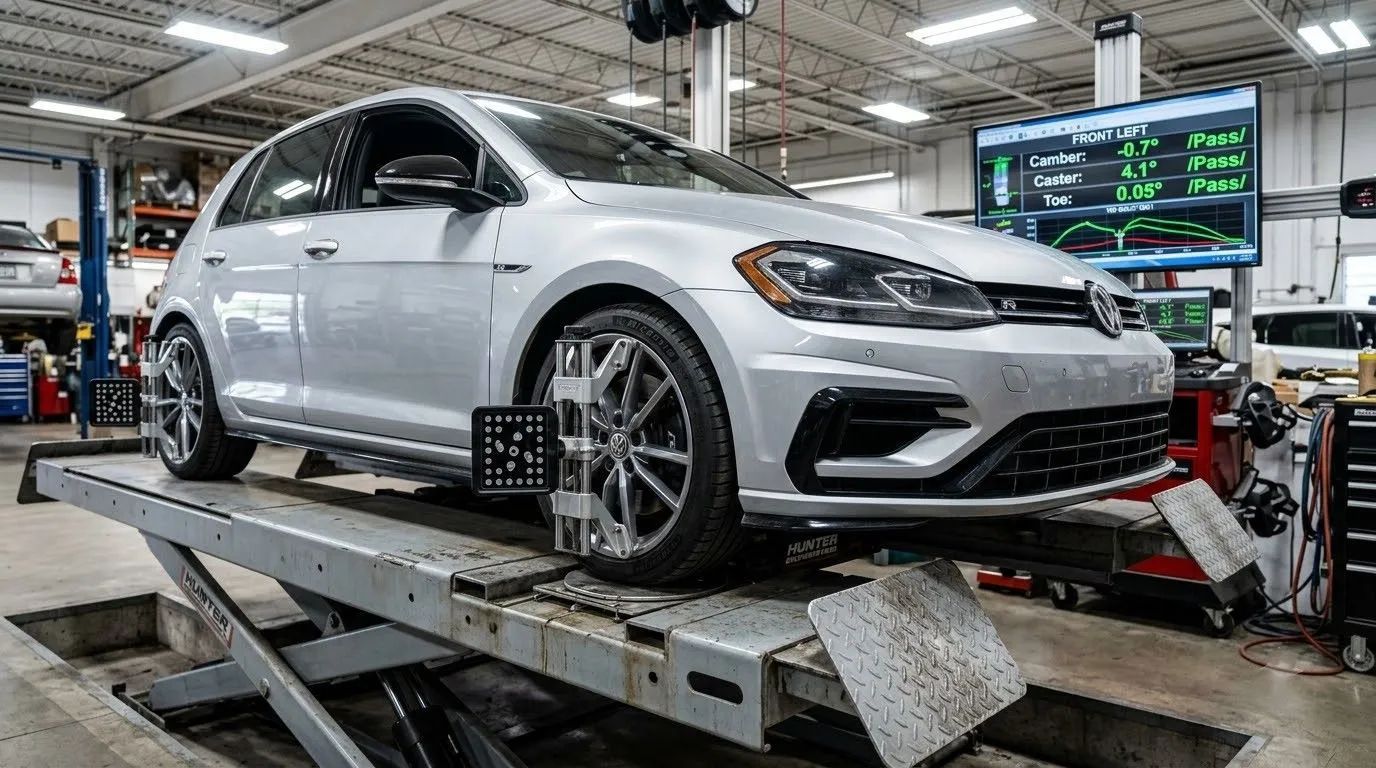
Then the targets go on all four wheels, and the rack reports camber, caster, toe, SAI, and thrust angle against the specification for that make, model, and year. We keep the first set of readings, make the adjustments the vehicle allows, and print a second set. The before and after printouts are the proof. They show which angles moved, how far, and where each one sits now. Shops that only describe the work leave you guessing about whether it happened.
Most alignments need no replacement parts at all. When a part is worn, we explain which one, why the evidence points to it, and put it on a written estimate before any work begins. Diagnosis comes first, and parts only come second.
Frequently Asked Questions
Which alignment angle matters most for tire life?
Toe wears tread fastest because an error drags the tire sideways on every revolution. Camber ranks next by overloading one shoulder, while caster mainly shapes stability and steering return.
Can I tell which angle is off just by looking at my tires?
Often you can get a hint. Shoulder wear suggests camber, feathered tread suggests toe, and scalloped wear suggests worn shocks or struts. A rack reading confirms it, since patterns overlap.
Why does my steering wheel sit crooked when the car drives straight?
The usual cause is a lopsided toe split between the front wheels. A rear thrust angle can do the same. The fix is setting toe evenly and aligning the rear wheels.
Can an alignment fix a car that pulls?
Sometimes. Uneven camber or caster causes alignment pulls, but a defective tire, sticking caliper, or worn suspension part does not. A technician should rule those out first so the pull does not return.
Do all vehicles have adjustable camber and caster?
No. Many vehicles adjust toe only, and others need extra hardware for camber or caster. When a fixed angle reads outside specification, a worn or bent part usually needs closer inspection.
Why do the angles have a published range instead of a single number?
Manufacturers allow a small tolerance because parts and ride height vary from car to car. The goal is bringing each angle inside its range, with left and right sides matched closely.
How often should the angles be checked?
No single mileage fits every driver. Check after a hard pothole or curb strike, suspension work, new tires, pulling, or uneven wear. Spring is sensible for assessing winter freeze and thaw damage.
Three Small Angles That Shape Every Drive
Camber, caster, and toe are three small angles with a large say in how a car tracks, steers, and wears its tires. Once each one is understood, the printout from the rack becomes something a driver can read, question, and trust. Camber leans the wheel, caster steadies the steering, and toe aims the tires, yet the three work together as a set. A reading that looks fine alone can hide a problem, so the full picture always matters most.
For 40
years, LUKE'S ALIGNMENT & AUTO REPAIR
has measured and set these angles for drivers in Chesterton, IN, and the patterns hold on every make and model. Freeze and thaw pavement, road salt, and short cold trips keep testing suspensions across Porter County. A careful inspection of worn parts before any adjustment keeps those angles where they belong. When the numbers stay true, tires last longer, the steering feels settled, and the road ahead needs far less correcting.