
Short black horizontal line on a white background

TIRE ROTATION

Tire manufacturers recommend rotation every 5,000 to 7,000 miles, and the reason is simple: front and rear positions wear at different rates on every vehicle built. Luke's Alignment & Auto Repair moves tires on that schedule from our Broadway Avenue shop, and this page covers the wear patterns we read, the rotation pattern each drivetrain requires, the warning signs on a tire that has sat too long in one position, and what even tread wear gives back to drivers in Chesterton, IN.
Two workers in hard hats crouch on a rooftop, working on the roof structure under a cloudy sky.
Person carrying wooden planks on a rooftop under a blue sky
TREAD YOU ALREADY PAID FOR SHOULD NOT GO TO WASTE.
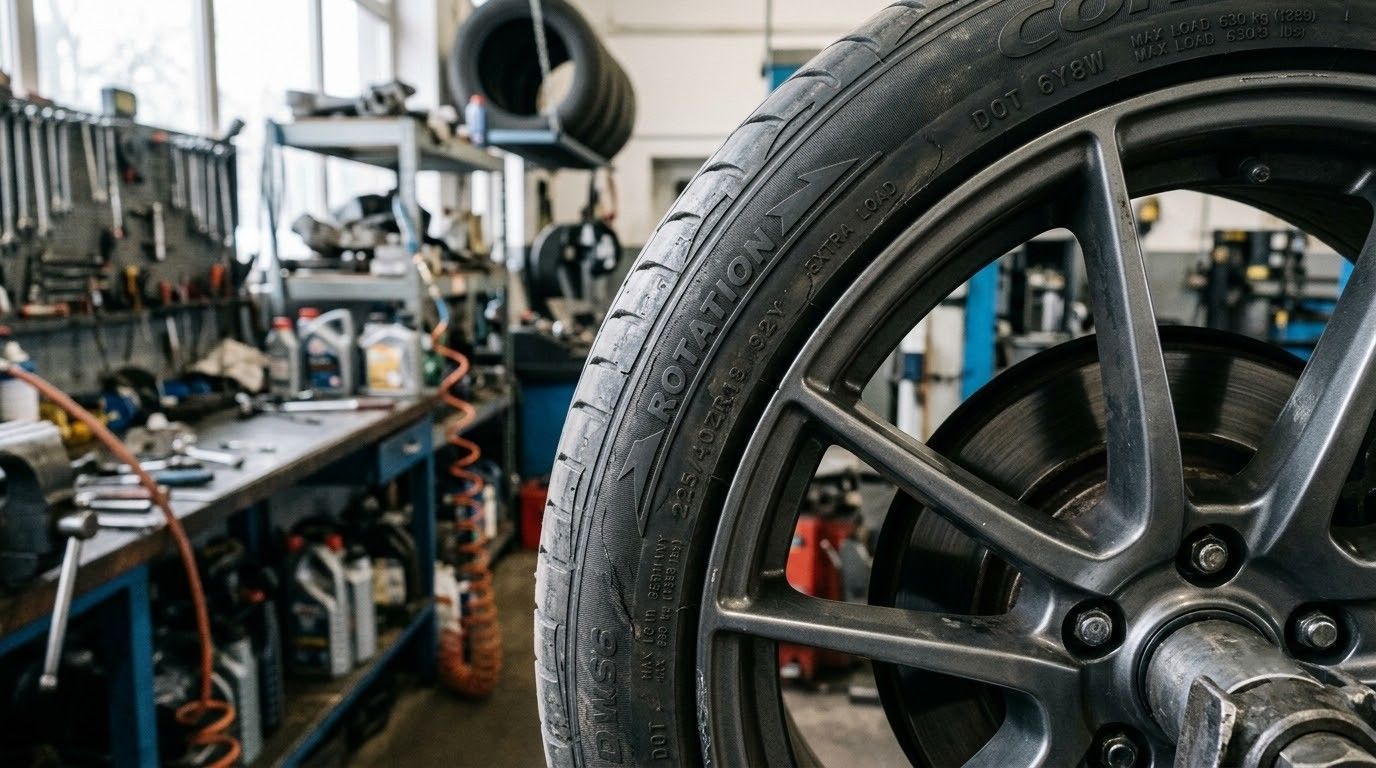
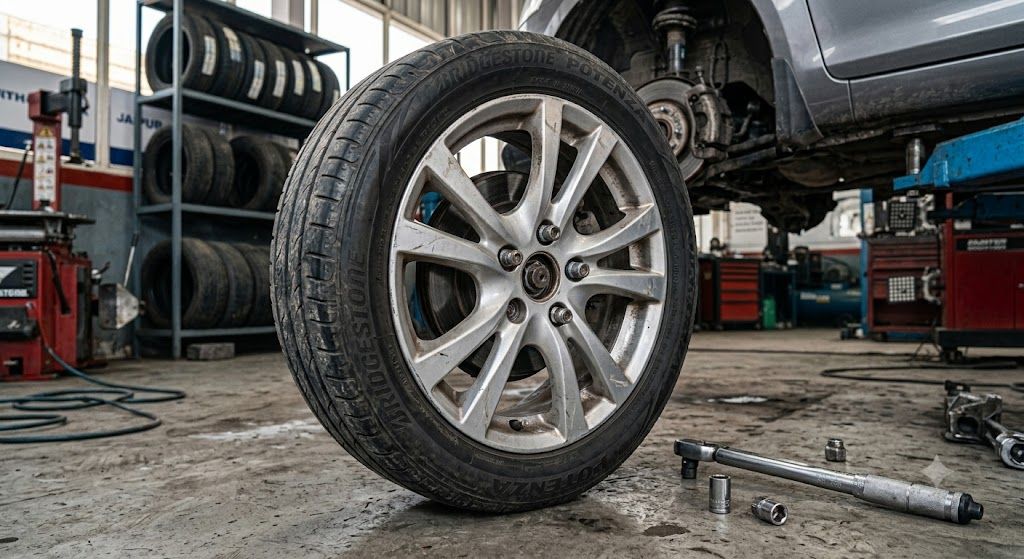
Leave four tires in the same corners for the life of a set and two of them will be finished long before the others. Steering, braking and drive loads all concentrate on specific positions, so one axle gives up its tread while the other pair still looks close to new. Moving them around evens out the workload. Doing it on schedule is cheap preventative maintenance. Tires come off, wear is measured across each shoulder and the center rib, and every one goes back in the position the manufacturer's pattern assigns it.
  • Rotation pattern matched to drivetrain
  • Wear read at every position
  • Pressures reset to placard figures
  • Every 5,000 to 7,000 miles
Black horizontal line on a white background.
TIRE ROTATION
WHY ROTATION MATTERS MORE ON DUNELAND ROADS.
Winter driving in this corner of Indiana rewards tread depth. Lake-effect snow arrives fast off Lake Michigan, and a car with two worn tires and two good ones behaves unpredictably the moment traction goes. Keeping all four wearing at the same rate means the vehicle responds the way it was engineered to, front and rear together, rather than pushing or stepping out because one axle ran out of grip first.
SALT, POTHOLES AND A SET THAT HAS TO LAST.
Porter County roads chew through rubber. Brine, coarse patch repairs and the broken edges left after a freeze all abrade tread faster than smooth pavement ever would, which makes an even wear rate worth real money over a set. Sticking to the interval also gets each tire off the vehicle regularly, so slow leaks and sidewall damage turn up before a driver finds them on the shoulder of I-94.
TREAD WEAR IS A STORY WE READ WEEKLY.
Feathered edges point at alignment. A polished center rib means overinflation, low shoulders mean the opposite, and a cupped surface usually means suspension. Our technicians have spent 40 years learning to tell those apart, and a set of tires will say plenty about what your driving, your alignment and the local roads have been doing to it, long before the tread runs out. Want to know what yours has been saying?
WHY CHOOSE US FOR TIRE ROTATION.
Black car on a car lift icon
Even Tread Wear
Rotating on the manufacturer's interval keeps all four tires wearing together, which is the whole point. A set that finishes at the same time is a set you replace once, not twice.
Black car on a car lift or jack icon
Pattern Matched To Drivetrain
Front wheel drive, rear wheel drive, all wheel drive and directional tires each need a different sequence. Getting that wrong wastes the visit, so we check the specification before any wheel moves.
Black car on a lift or jack stand icon
Traction You Can Count On
Snow and standing water punish mismatched tread depths. Keeping the four corners within a close range of each other means braking and cornering stay predictable through a Northwest Indiana winter.
Black car icon on a car lift
More Miles Per Set
A set that shares the workload lasts noticeably longer than one that does not. Rotation is among the least expensive things a driver can do to stretch the time between replacements.
Black car on a car lift or jack stand icon
Problems Found Early
Pulling every tire off the vehicle is a free look at what is happening underneath. Slow leaks, embedded nails, damaged sidewalls and loose bushings all surface during a rotation visit.
Black car icon on a car lift, symbolizing vehicle maintenance or inspection
In And Out The Same Day
Rotation is quick preventative work, not a teardown. Book it alongside an oil change or a brake check and the vehicle is usually back with you the same day it arrives.
Black horizontal line on a white background

our services

OUR TIRE ROTATION WORK
Every rotation visit is short, but several things happen inside it. Here is what our technicians actually do between lifting the vehicle and handing the keys back, and why the sequence matters more than the speed.
Person carrying wooden planks on a rooftop under a blue sky
WEAR READ
Tread Wear Assessment

Each tire gets measured across the outer shoulder, the center and the inner shoulder before it moves. Those three numbers tell us whether the vehicle needs alignment, different pressures, or simply the next rotation on time.
Two workers in hard hats repairing a shingled roof under a cloudy sky.
FRONT DRIVE
Front Wheel Drive Rotation

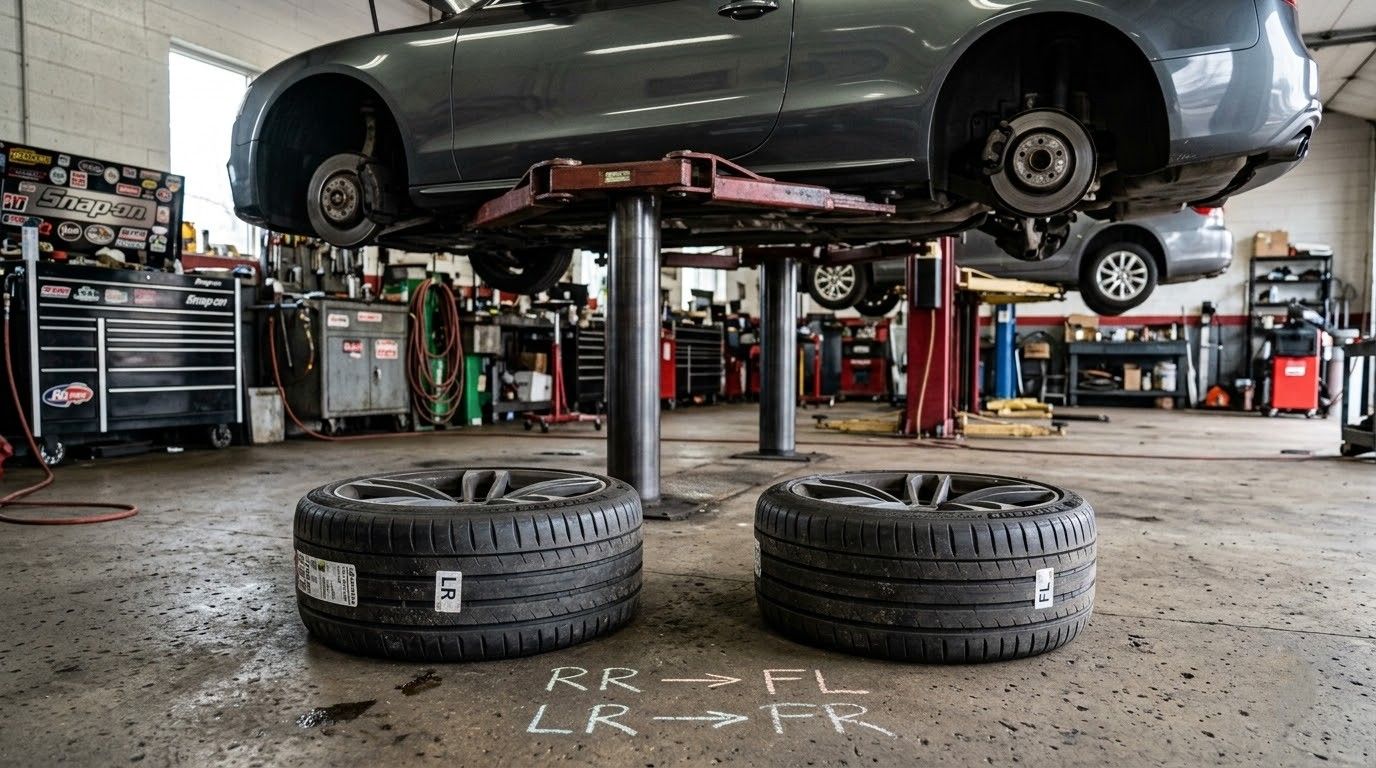
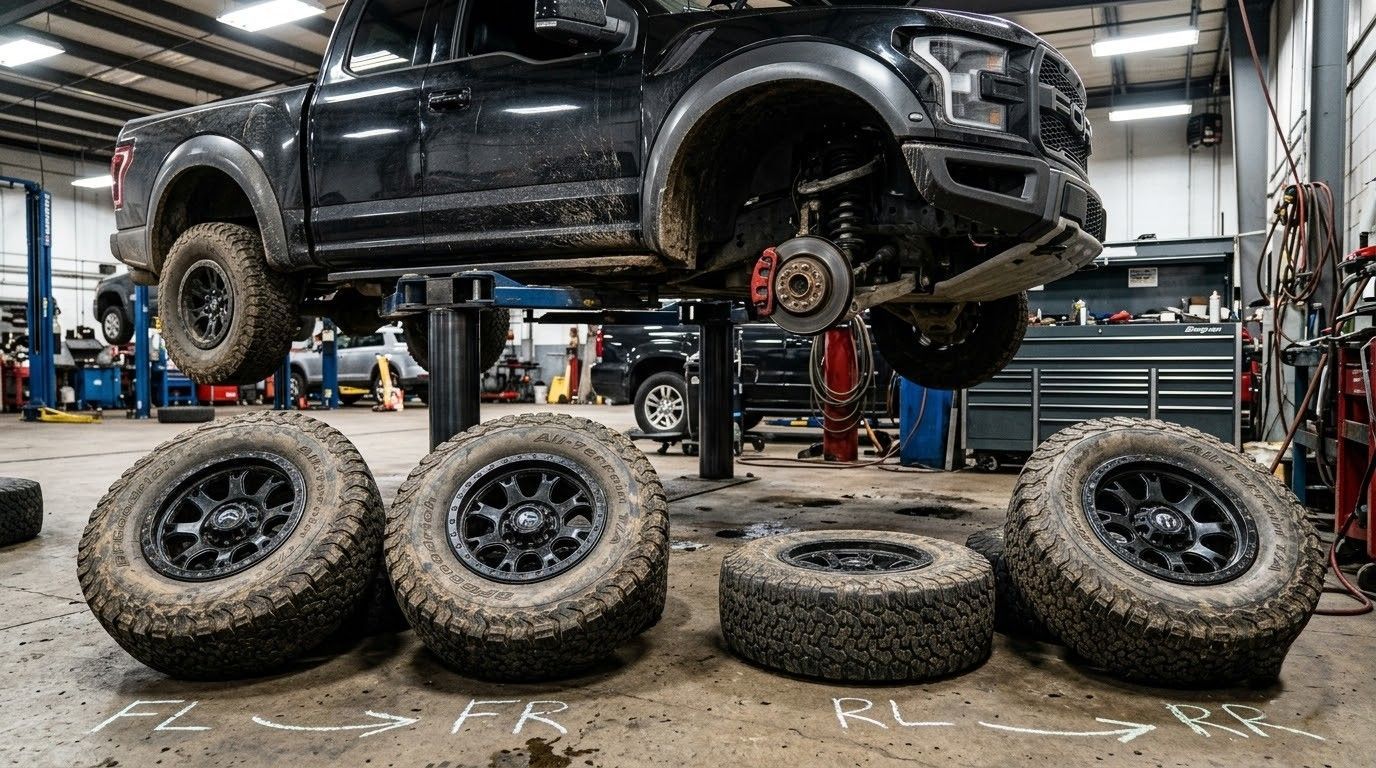
Driven front tires wear their shoulders faster, so the standard pattern brings them straight back and crosses the rear pair forward. Most cars and crossovers on local streets fall into this category.
Two roofers wearing hard hats work on a shingled roof, one kneeling and one leaning forward.
REAR DRIVE
Rear and All Wheel Drive Rotation

Rear driven and all wheel drive vehicles use the opposite sequence, with the rears moving straight forward and the fronts crossing to the back. Trucks and SUVs almost always need this pattern instead.
House roof with steam or smoke rising from a damaged section near the gutter
DIRECTIONAL TIRES
Directional and Staggered Sets

Directional tread can only run one way, and staggered fitments use different sizes front and rear. Both limit where a tire may go, so we confirm sidewall markings and sizes before deciding anything.
Two workers on a shingled roof, one kneeling with a hammer and one sitting nearby under a cloudy sky
PRESSURE SET
Pressure and Valve Check

Inflation goes back to the door placard figure rather than the number stamped on the sidewall. Valve stems and caps get checked at the same time, since a perished stem leaks quietly all winter.
Snow-covered rooftops under a clear blue sky
LUG TORQUE
Wheel Torque and Retorque

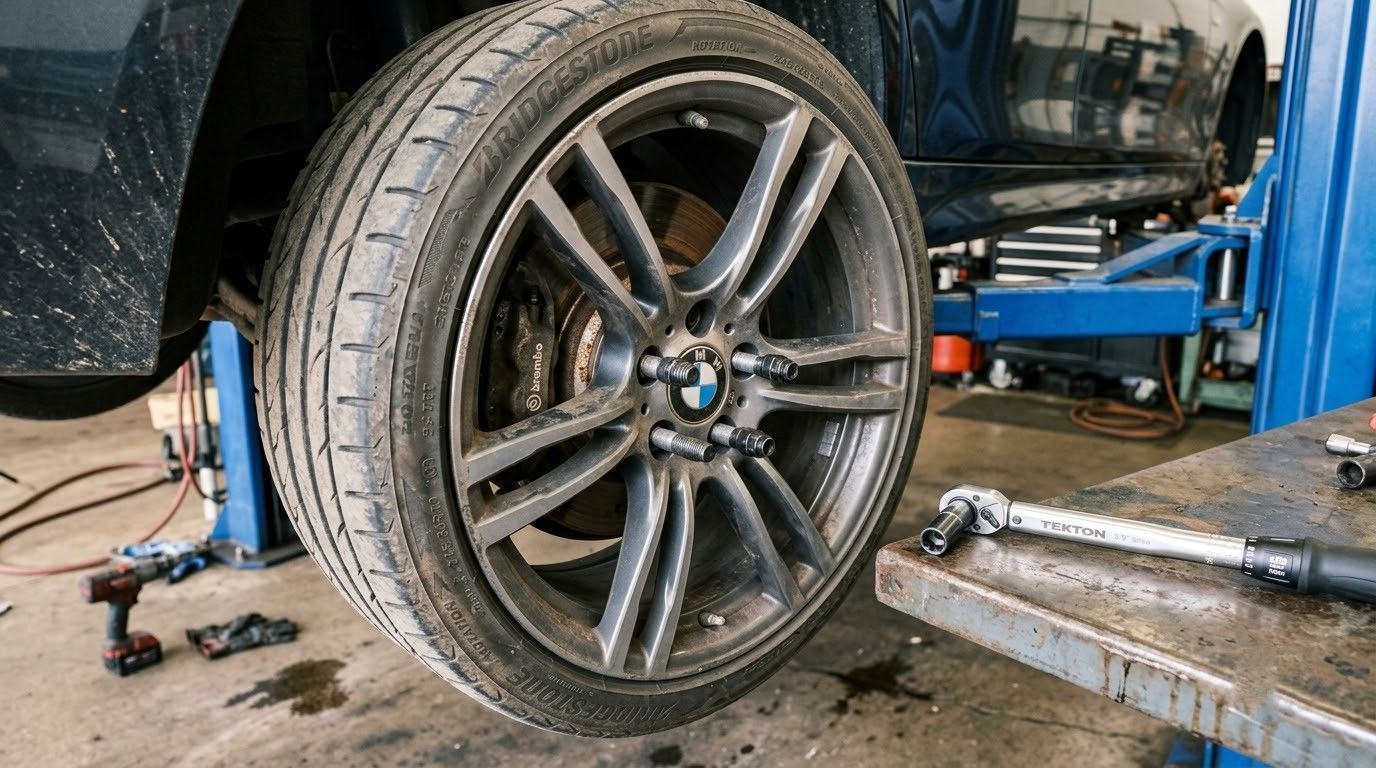
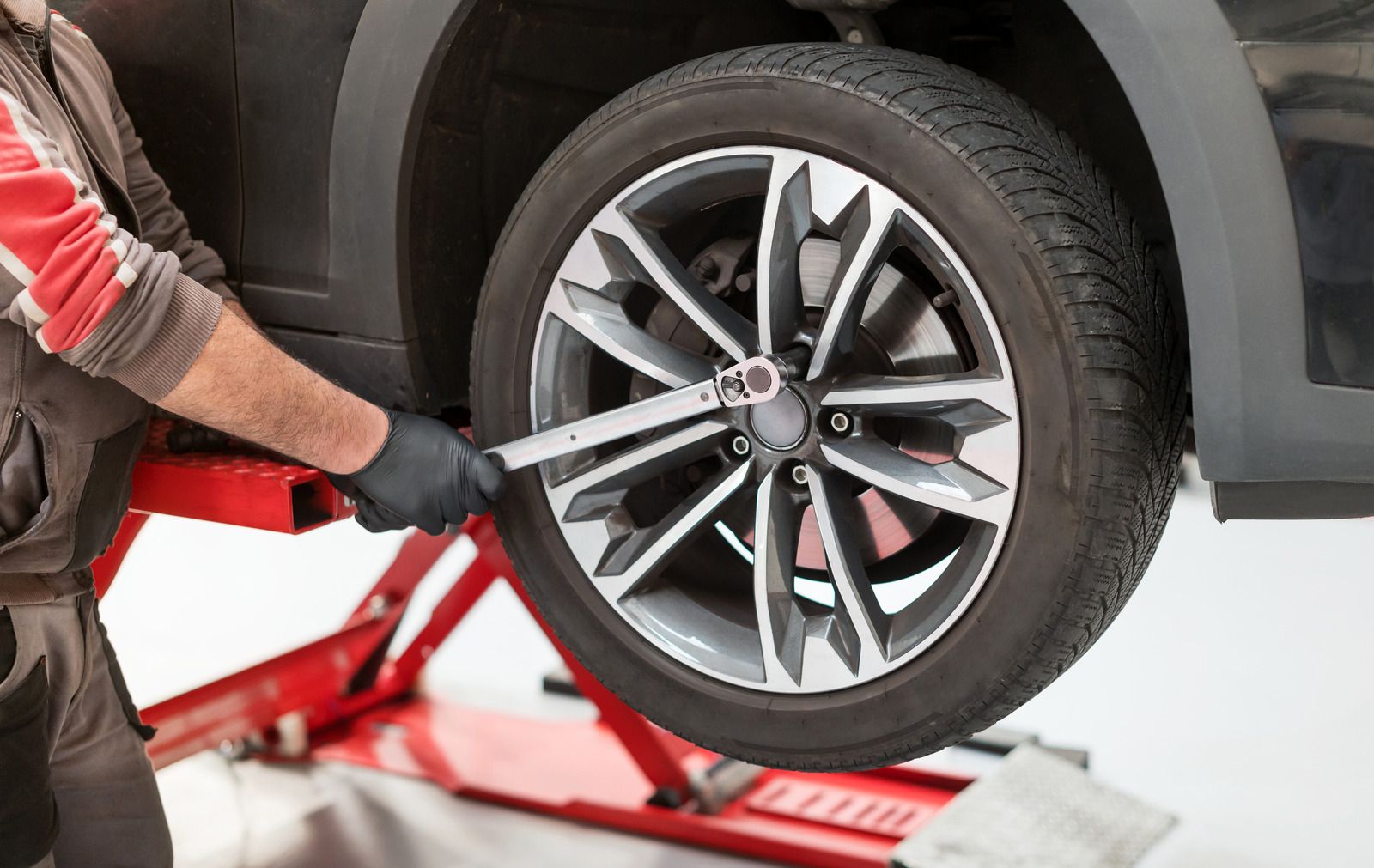
Wheels go back on in a star sequence to the figure the manufacturer publishes, never by feel on a rattle gun. Uneven clamping load warps rotors and loosens studs, both of which cost far more later.
Black horizontal rounded bar on a white background

THE WORD ON OUR WORK

WHAT OUR CLIENTS SAY.
Regulars book rotation the way other people book a haircut, and that habit is why some sets on Porter County roads reach replacement mileage looking almost even across all four. What gets mentioned back to us most is that nothing extra ever appears on the invoice.
Black horizontal line on a white background
Common Questions
FREQUENTLY ASKED QUESTIONS.
New tires raise a predictable set of questions, and rotation is where most of them start. These are the ones we answer most often at our counter on Broadway Avenue.

When should I get my tires rotated?

Generally between 5,000 and 8,000 miles, or at least every six months, whichever arrives first. Brands differ, so the tire manufacturer's own guidance is the precise answer for your set, and we follow it rather than a shop default.


What does uneven wear on one tire mean?

It points at a cause rather than the tire itself. Feathering across the tread suggests alignment, cupping suggests failing shocks, and heavy shoulder wear suggests underinflation. Reading the pattern tells us which repair actually solves the problem.


Why does the rotation pattern change between vehicles?

Because the driven axle does more work. A front wheel drive car wears its front tires fastest, so those move rearward, while a rear driven vehicle needs the reverse. Directional tread and staggered sizes narrow the options further.


Can I skip rotation if my tires still look fine?

Looking fine and wearing evenly are different things, and by the time a difference is visible the tread is already gone. Luke's Alignment & Auto Repair measures depth at every position in Chesterton, IN so the decision rests on numbers.


Should rotation happen at the same time as an oil change?

Pairing them works well because the intervals overlap closely and the vehicle is already on the lift. Combining the two saves a separate trip and means the tires get looked at several times a year.


What if one tire is much more worn than the other three?

That tire usually cannot simply be moved. Mixing a badly worn tire with three healthy ones affects handling and, on all wheel drive vehicles, the drivetrain itself. Replacement in pairs is normally the safer route.


Does the spare go into the rotation?

Only if it is a full size matching tire, in which case a five tire rotation keeps the whole set even. Compact temporary spares stay where the manufacturer put them and never enter the pattern.


Do tires that lose air slowly need attention during rotation?

Yes. A tire dropping pressure over weeks usually has a valve stem, bead seal or corroded rim problem rather than a puncture. Luke's Alignment & Auto Repair inspects for that at every rotation in Chesterton, IN.


    Black horizontal line on a white background.
    HOW WE WORK
    SIX STEPS BETWEEN A WORN SET AND AN EVEN ONE.

    Step-01

    CHECK THE MILEAGE AND THE HISTORY.
    Knowing when the last rotation happened, how far the vehicle has run since, and what the manufacturer specifies sets the pattern before anything comes apart. Vehicles that tow or carry weight regularly often need a shorter interval.

    Step-02

    MEASURE TREAD AT EVERY POSITION.
    Depth readings come off the inner shoulder, center and outer shoulder of all four tires. Anything approaching 2/32 inch gets flagged straight away, since that figure is the minimum legal tread depth anywhere in Indiana.

    Step-03

    CONFIRM THE PATTERN FOR THIS VEHICLE.
    Drivetrain, tire type and wheel sizes decide where each tire is allowed to go. Getting this right is the part that takes attention to detail, and it is why a rotation is not simply swapping wheels around.

    Step-04

    MOVE EACH TIRE TO ITS NEW CORNER.
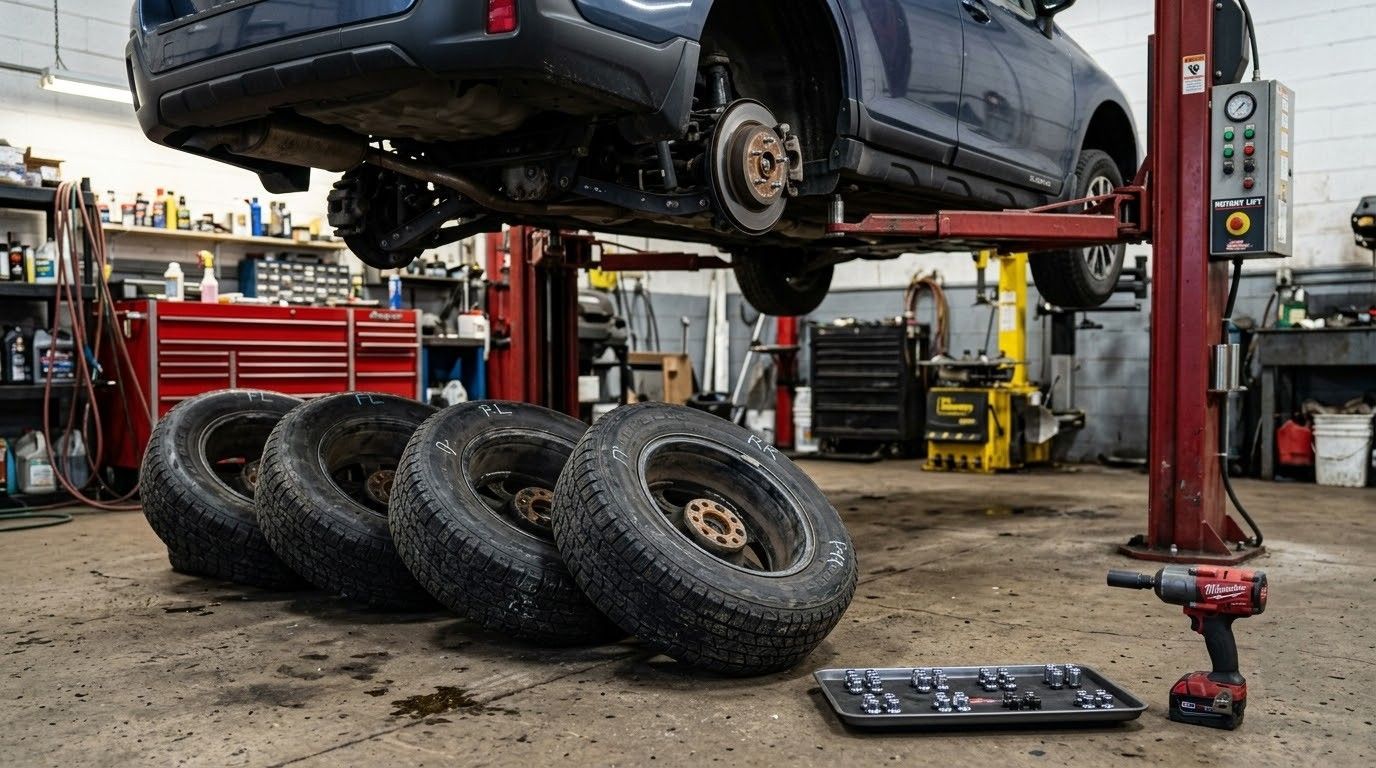
    Hub faces get cleaned of rust and brake dust as the wheels come off, and each tire goes to the position the pattern assigns. Anything found during the swap, from a nail to a split bushing, gets noted.

    Step-05

    RESET PRESSURES AND TORQUE THE LUGS.
    Pressures return to the placard figure, cold, and every wheel is torqued in sequence to specification. Vehicles with a monitoring system get the sensors relearned so the dash reads the correct corner from the first mile afterward.

    Step-06

    REPORT WHAT THE TREAD SHOWED US.
    You leave knowing the depth at each corner, which tires are ahead of the others, and roughly how many miles the set has left. If the wear pattern pointed at alignment or suspension, we say so plainly.
    Thin black horizontal line on a white background
    GET YOUR FREE ESTIMATE
    BOOK THE NEXT ROTATION, WITH A WRITTEN ESTIMATE, FREE.
    Moving four tires is the least dramatic maintenance a vehicle needs and among the most rewarding, because it quietly adds miles to a set you already own. Send your mileage and tire details through our contact page and we will book a slot.

    WHAT YOUR FREE QUOTE COVERS:

    ✓  Tread depth at all four corners

    ✓  The correct pattern for your drivetrain

    ✓  Pressure and valve stem condition

    ✓  Wheel torque to manufacturer specification

    ✓  Notes on any uneven wear found

    ✓  A written figure with no obligation